
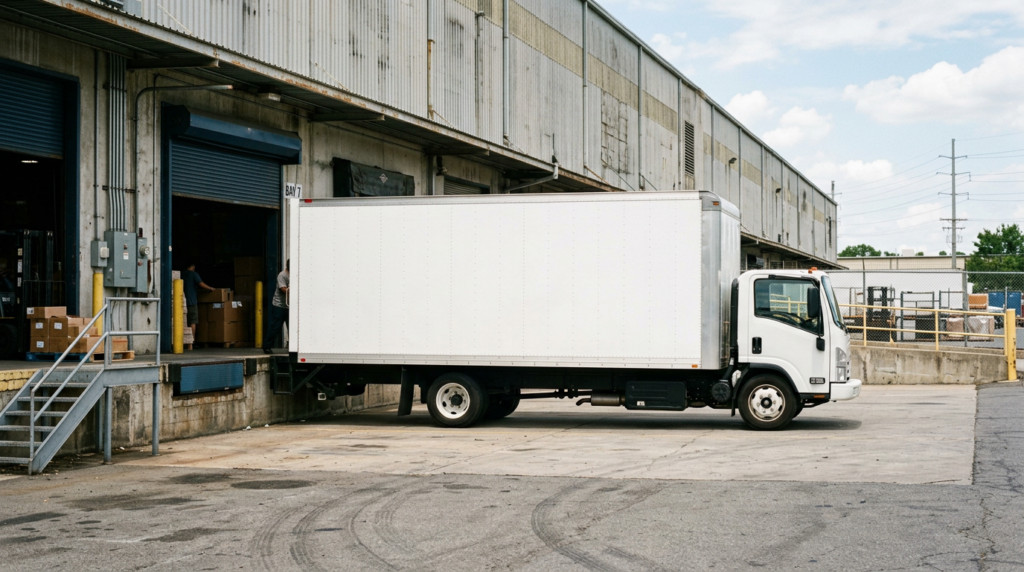
Short answer: Yes, if your box truck has a gross vehicle weight rating (GVWR) of 10,001 pounds or more and you use it for business across state lines. Most 16 to 26 foot box trucks are rated well over 10,001 pounds. Even if you never leave your state, 38 states and Puerto Rico require a USDOT number for intrastate commercial vehicles. You do not need a CDL for a box truck rated 26,000 pounds or less unless you haul placarded hazardous materials.
Step 1: Find your GVWR
The GVWR is printed on the manufacturer’s label inside the driver’s door frame. It is the maximum loaded weight the truck is rated for, not what it weighs empty and not what you actually carry. If you pull a trailer, use the combined rating (GCWR) of the truck and trailer.
| GVWR | Typical vehicle | USDOT number (interstate) | CDL needed |
|---|---|---|---|
| Under 10,001 lbs | Cargo van, small pickup | Not required by weight | No |
| 10,001 to 26,000 lbs | Most 16 to 26 ft box trucks | Yes | No (unless placarded hazmat) |
| 26,001 lbs or more | Heavy straight trucks, tractors | Yes | Yes |
Step 2: Interstate or intrastate?
Interstate commerce means your business crosses a state line, or the freight is on its way to or from another state or country, even if your truck stays in one state for that leg. If you are interstate and at 10,001 pounds or more, you need a USDOT number.
If you truly stay in one state, check your state rules. According to FMCSA, these states require intrastate commercial vehicles to have a USDOT number: Alabama, Alaska, Arizona, California, Colorado, Connecticut, Delaware, Florida, Georgia, Hawaii, Idaho, Indiana, Iowa, Kansas, Kentucky, Maine, Maryland, Massachusetts, Michigan, Minnesota, Missouri, Montana, Nebraska, Nevada, New Jersey, New York, North Carolina, Ohio, Oklahoma, Oregon, Pennsylvania, South Carolina, Texas, Utah, Washington, West Virginia, Wisconsin and Wyoming, plus Puerto Rico. Each state sets its own weight thresholds, so confirm with your state agency.
Step 3: For-hire or your own goods?
If you haul other people’s freight for pay across state lines, you are a for-hire carrier. On top of the USDOT number you need operating authority from FMCSA, a BOC-3 process agent filing, and insurance filed with FMCSA. For general freight in a truck rated 10,001 pounds or more, the federal minimum liability insurance is $750,000.
If you only move your own company’s goods, such as a contractor carrying their own equipment, you are a private carrier. You still need the USDOT number, but not for-hire operating authority or a BOC-3.
What else a box truck business needs
- USDOT number displayed on both sides of the truck, with your legal or trade name.
- UCR registration every year if you operate interstate.
- Medical card for every driver of a 10,001-pound-plus truck in interstate commerce.
- Driver qualification file for every driver, including yourself.
- Hours of service records, and an ELD unless you qualify for an exemption such as short-haul.
- Annual vehicle inspection and daily inspection reports.
- A new entrant safety audit within your first 12 months under a new USDOT number.
Non-CDL box trucks are not in the DOT drug and alcohol testing program, which only covers CDL drivers.
How to get the USDOT number
You apply in Motus, FMCSA’s registration system, using a Login.gov account. The USDOT number itself is free; operating authority carries a federal filing fee. Have your legal business name, EIN, physical address, vehicle count and type of operation ready.
Our Company Launch Package sets up your USDOT number, operating authority and first filings, and our team walks you through the first year. Talk to a real person.
See the Company Launch PackageCall (877) 922-5666Quick answers
Do I need a DOT number for a 26 ft box truck?
Almost always for business use. A 26 ft box truck is typically rated just under 26,001 pounds, so it needs a USDOT number for interstate work but no CDL.
Do I need a DOT number for a cargo van?
Usually not by weight, since most cargo vans are rated under 10,001 pounds. If you haul for hire across state lines, check whether you still need operating authority.
Does renting a box truck change anything?
If you rent a truck to run your own business, the USDOT number has to be yours as the operator, not the rental company’s.
Is the USDOT number free?
Yes, FMCSA does not charge for the USDOT number itself. Filing services like ours charge for doing the work for you.
Sources: FMCSA: Do I need a USDOT number?; 49 CFR 387.9, minimum levels of financial responsibility.
US Permit is a private third-party provider, not affiliated with FMCSA, USDOT, or any government agency. This guide is general information, not legal advice.